
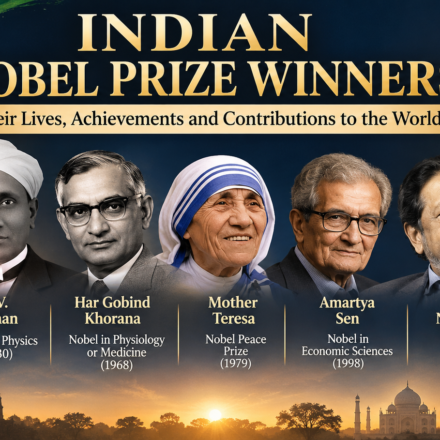




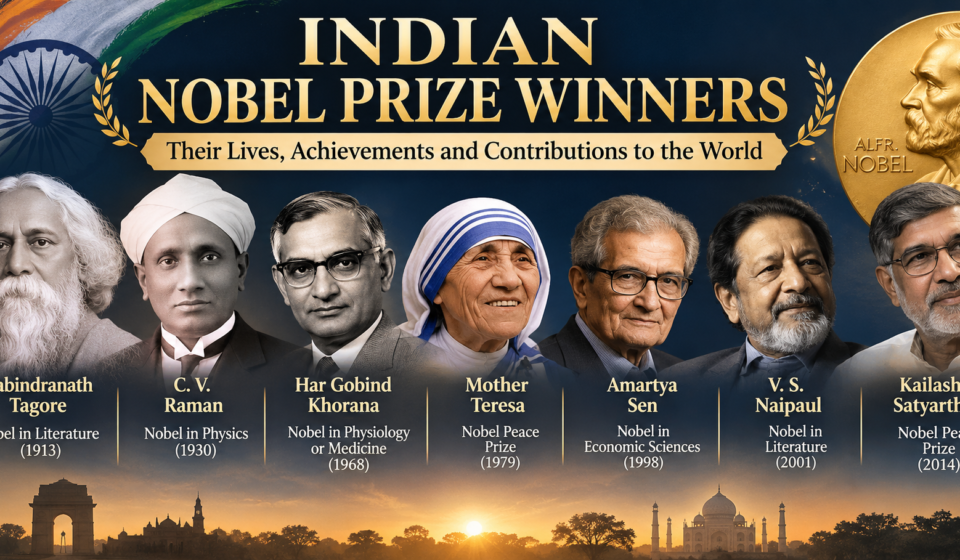

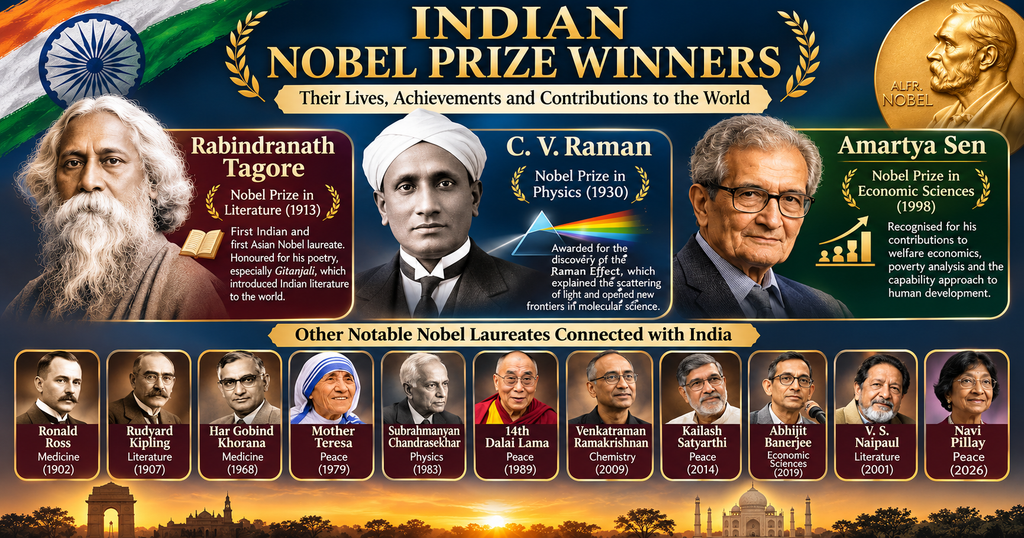
Indian Nobel Prize Winners: Their Lives, Achievements and Contributions to the World
The Nobel Prize is one of the world’s most respected international awards. The award has recognized individuals and organizations whose work advances humanity, including Indian Nobel Prize Winners. Since 1901, Nobel laureates have been recognized for achievements in physics, chemistry, physiology or medicine, literature and peace. The Sveriges Riksbank Prize in Economic Sciences in Memory of Alfred Nobel began later, with the first award in 1969.
India has a significant place in Nobel Prize history. Its connection with the award began in 1913, when Rabindranath Tagore received the Nobel Prize in Literature. He became the first Asian Nobel laureate. His achievement introduced Indian literature to a much wider international audience.
In the years that followed, other individuals born in India or closely connected with the country received Nobel recognition. Their achievements covered several fields. C. V. Raman transformed the study of light. Har Gobind Khorana helped scientists understand the genetic code. Subrahmanyan Chandrasekhar advanced our understanding of stars. Amartya Sen changed the way economists examine poverty and human welfare however contributions of these laureates extend far beyond academic research. Mother Teresa devoted her life to humanitarian service. Kailash Satyarthi brought international attention to child labor and children’s rights. The 14th Dalai Lama received the Nobel Peace Prize for advocating peaceful solutions and non-violence.
India’s Nobel Prize story also includes people who were born in the country when it was under British rule. Ronald Ross and Rudyard Kipling were born in British India but received their Nobel Prizes as British nationals. Their biographies are relevant to the country’s historical record, although they should not be classified as Indian citizens.
The story continues into 2026. Navi Pillay, a South African jurist of Indian Tamil ancestry, received the 2026 Nobel Peace Prize for her efforts to promote peace and international law. Her achievement adds another important dimension to the global influence of people with Indian roots.
This article explores the lives, education, careers and achievements of Nobel laureates with Indian connections. It also explains why they received their awards and how their contributions continue to influence the world.
Understanding India’s connection with the Nobel Prize
Before examining individual biographies, it is necessary to clarify what the term Indian Nobel Prize winner means.
It can refer to several different groups of people:
- People born in present-day India who later received a Nobel Prize.
- People born in British India before the Partition of 1947, in territories that are now part of India or Pakistan.
- Indian citizens who received the Nobel Prize while living or working abroad.
- Foreign-born individuals who spent much of their lives working in India.
- Foreign nationals born in India during the colonial period.
- People born outside India who have Indian ancestry and later received a Nobel Prize.
These distinctions are important. Birthplace, nationality, residence and ancestry are not interchangeable. For example, Har Gobind Khorana and Subrahmanyan Chandrasekhar were born in British India, but their birthplaces are now in Pakistan. Mother Teresa was born in present-day North Macedonia but spent most of her adult life working in India. The Dalai Lama was born in Tibet and has lived in India since 1959. Similarly, V. S. Naipaul was born in Trinidad and Tobago to a family of Indian ancestry. Navi Pillay was born in South Africa to a family of Indian Tamil descent. For clarity, this article uses separate categories for these different connections. It covers ten laureates born in British India, two foreign-born laureates whose lives were closely connected with India, and two additional laureates of Indian ancestry. This approach provides a wider historical picture without making inaccurate claims about nationality.
Table of Contents
- Rabindranath Tagore – Nobel Prize in Literature, 1913
- C. V. Raman – Nobel Prize in Physics, 1930
- Har Gobind Khorana – Nobel Prize in Medicine, 1968
- Mother Teresa – Nobel Peace Prize, 1979
- Subrahmanyan Chandrasekhar – Nobel Prize in Physics, 1983
- The 14th Dalai Lama – Nobel Peace Prize, 1989
- Amartya Sen – Nobel Prize in Economic Sciences, 1998
- Venkatraman Ramakrishnan – Nobel Prize in Chemistry, 2009
- Kailash Satyarthi – Nobel Peace Prize, 2014
- Abhijit Banerjee – Nobel Prize in Economic Sciences, 2019
- Ronald Ross – Nobel Prize in Medicine, 1902
- Rudyard Kipling – Nobel Prize in Literature, 1907
- V. S. Naipaul – Nobel Prize in Literature, 2001
- Navi Pillay – Nobel Peace Prize, 2026
- Nobel Prize winners connected with India: A comparative overview
- India’s contribution to the Nobel Prize
- Frequently Asked Questions
- Conclusion
- References and Further Reading
1. Rabindranath Tagore – Nobel Prize in Literature, 1913
Field: Literature
Year of award: 1913
Born: 7 May 1861
Birthplace: Calcutta, British India (now Kolkata, India)
Died: 7 August 1941
Connection with India: Indian poet, writer, philosopher and educator.
Rabindranath Tagore holds a special place in India’s literary and cultural history. He was the first Indian to receive a Nobel Prize and the first Asian to win the Nobel Prize in Literature.
His achievement was not limited to poetry. Tagore was a novelist, short-story writer, playwright, composer, philosopher, educator and painter. His creative work influenced generations of readers and artists in India and abroad.
His Nobel Prize in 1913 marked an important moment in the international recognition of Indian literature.
Early life and family background
Rabindranath Tagore was born on 7 May 1861 in Calcutta, then the capital of British India. He belonged to the influential Tagore family of Jorasanko.
His father, Debendranath Tagore, was a philosopher and an important figure in the Brahmo Samaj movement. His mother was Sarada Devi.
The Tagore household was a center of intellectual and cultural activity. Music, literature, philosophy and social reform were part of everyday life. Rabindranath grew up in an environment that encouraged independent thinking and artistic expression.
He began composing poetry at a young age. His early literary experiments showed an unusual command of language and imagination.
Tagore did not enjoy conventional classroom education. Much of his learning took place at home, where he studied literature, history, science, music and philosophy.
In 1878, he traveled to England to study. However, he did not complete a conventional university degree. He returned to India and continued developing his literary career.
Literary career and major works
Tagore wrote in Bengali, but his work eventually reached readers across the world.
His literary output covered several forms:
- Poetry and songs
- Novels and short stories
- Plays and dramatic works
- Essays and philosophical writing
- Literary criticism
- Educational and social commentary
Some of his best-known works include Gitanjali, Gora, Ghare-Baire, Chokher Bali and The Post Office.
His short stories explored ordinary human experiences. They often dealt with family relationships, social expectations, poverty, gender roles and the emotional lives of people who were usually overlooked in mainstream literature.
His novels examined the tensions between tradition and modernity. He questioned social inequalities and explored the changing position of individuals in a society undergoing political and cultural transformation.
Tagore also composed thousands of songs. This body of work, known as Rabindra Sangeet, remains an important part of Bengali culture.
Two national anthems are associated with him. India’s national anthem, Jana Gana Mana, was written by Tagore. Bangladesh’s national anthem, Amar Shonar Bangla, was also composed by him.
Why did Rabindranath Tagore win the Nobel Prize?
Tagore received the Nobel Prize in Literature in 1913, primarily for his collection Gitanjali: Song Offerings.
The English version of Gitanjali was published in London in 1912. It contained translations of selected poems, many of which Tagore had originally written in Bengali.
The English edition helped introduce his poetry to international readers. Its language, spiritual reflections and emotional depth attracted considerable attention.
The Nobel Committee recognized the quality of his poetry and its ability to communicate ideas across cultural boundaries.
Tagore was not simply translating words from one language into another. He was introducing a different literary sensibility to readers who had limited exposure to Indian writing.
His Nobel Prize also challenged the assumption that major literary achievements came primarily from Europe.
Contribution to education and society
Tagore believed that education should encourage curiosity, creativity and independent thought.
In 1901, he established an experimental school at Santiniketan in Bengal. He wanted students to learn in a natural environment rather than remain confined to traditional classrooms.
The institution later developed into Visva-Bharati University, formally established in 1921.
His educational philosophy placed importance on art, music, literature, nature and international cultural exchange.
Tagore also traveled extensively. He visited several countries and spoke about education, nationalism, culture and the relationship between civilizations.
Although he supported India’s freedom from colonial rule, he was critical of aggressive nationalism. He believed that national identity should not become an excuse for hostility towards other people.
In 1919, following the Jallianwala Bagh massacre, he renounced the knighthood awarded to him by the British government.
This decision reflected his opposition to colonial violence.
Legacy
Rabindranath Tagore died on 7 August 1941 in Calcutta.
His influence remains visible in literature, music, education and cultural life. His songs continue to be performed, his writings are studied in universities, and Santiniketan remains associated with his educational vision.
Tagore’s Nobel Prize was more than an individual literary achievement. It established an important international connection between Indian writing and world literature.
He remains the starting point of any serious account of Indian Nobel Prize winners.
Official reference: Rabindranath Tagore – Nobel Prize in Literature 1913
2. C. V. Raman – Nobel Prize in Physics, 1930
Field: Physics
Year of award: 1930
Born: 7 November 1888
Birthplace: Tiruchirappalli, Madras Presidency, British India (now Tamil Nadu, India)
Died: 21 November 1970
Connection with India: Indian physicist and scientific researcher.
Sir Chandrasekhar Venkata Raman, popularly known as C. V. Raman, was one of India’s most influential physicists.
He became the first Indian to receive the Nobel Prize in Physics. His discovery of the Raman Effect changed the study of light and molecular structure.
His work also demonstrated that internationally recognized scientific research could be carried out in India.
Early life and education
C. V. Raman was born on 7 November 1888 in Tiruchirappalli, Tamil Nadu.
His father, Chandrasekhar Ramanathan Iyer, taught mathematics and physics. This gave Raman early exposure to scientific subjects.
Raman showed exceptional academic ability. He joined Presidency College in Madras at a young age and completed his bachelor’s degree in 1904.
He received his master’s degree in 1907, achieving outstanding results in physics.
At the time, scientific research did not offer many secure career opportunities in India. Raman therefore joined the Indian Finance Department.
However, his government employment did not end his scientific interests. He continued conducting experiments in his spare time.
He used the facilities of the Indian Association for the Cultivation of Science in Calcutta. This institution became important in the development of his early research.
Scientific career
Raman’s early research focused on optics and acoustics.
He was particularly interested in how light interacts with matter. He studied the scattering of light and the behaviour of different materials under various conditions.
In 1917, he left government service and joined the University of Calcutta as a professor of physics.
This allowed him to devote more time to research.
His work attracted attention within the scientific community. He became known for his experimental skill and ability to investigate difficult physical questions with relatively simple equipment.
In 1924, he was elected a Fellow of the Royal Society.
His most important discovery came in 1928.
What is the Raman Effect?
When light passes through a transparent material, most of the scattered light retains the same frequency as the incoming light.
However, a very small portion of the scattered light has a different frequency.
This change occurs because light interacts with the molecules of the material. During the interaction, energy can be exchanged between the light and the molecular vibrations or rotations.
The resulting change in frequency is known as the Raman Effect.
Raman and his collaborators experimentally demonstrated this phenomenon on 28 February 1928.
The discovery provided a new method for studying the molecular structure of substances.
Today, Raman spectroscopy is widely used in chemistry, physics, materials science, pharmaceuticals, biology and other research fields.
It helps scientists identify materials and study their molecular properties without necessarily destroying the sample.
Why did C. V. Raman win the Nobel Prize?
The Nobel Prize in Physics was awarded to Raman in 1930 for his work on the scattering of light and the discovery of the effect named after him.
His discovery provided experimental evidence that light scattering could reveal information about molecular energy states.
It created a new direction in spectroscopy and gave researchers an additional tool for investigating matter.
One notable aspect of Raman’s achievement was that the work was carried out in India.
At a time when major scientific institutions were concentrated in Europe and North America, his research demonstrated the potential of Indian scientific institutions.
Other scientific contributions
Raman’s interests extended beyond the discovery that bears his name.
He investigated acoustics and musical instruments, the diffraction of light, optical properties of crystals, molecular scattering and the behaviour of diamonds and other materials.
He also explored the physics of musical instruments, including Indian stringed and percussion instruments.
His scientific curiosity was broad. He was interested in understanding the physical principles behind everyday phenomena.
Later life and legacy
Raman became the first Indian director of the Indian Institute of Science in Bengaluru and later founded the Raman Research Institute.
He received several honours during his lifetime, including the Bharat Ratna in 1954.
He died on 21 November 1970 in Bengaluru.
India celebrates National Science Day on 28 February every year to commemorate the discovery of the Raman Effect.
His Nobel Prize remains a major milestone in the history of Indian science.
Raman’s legacy is not limited to a single discovery. He helped establish a research culture in India and inspired generations of physicists.
Official reference: C. V. Raman – Nobel Prize in Physics 1930
3. Har Gobind Khorana – Nobel Prize in Physiology or Medicine, 1968
Field: Physiology or Medicine
Year of award: 1968
Born: 9 January 1922
Birthplace: Raipur, Punjab, British India (now in Pakistan)
Died: 9 November 2011
Connection with India: Born in British India; later conducted major research in Canada and the United States.Har Gobind Khorana was a pioneering biochemist whose research helped explain how genetic information is translated into proteins. His work contributed to one of the most important scientific advances of the twentieth century: understanding the genetic code.Khorana shared the 1968 Nobel Prize in Physiology or Medicine with Robert W. Holley and Marshall W. Nirenberg.Although he later became a naturalised United States citizen, his early life and education were rooted in the Indian subcontinent.
Early life and family background
Khorana was born in Raipur, a village in Punjab under British rule. The village is now in Pakistan.His family had limited financial resources. His father worked as a village agricultural taxation official. Despite their circumstances, his parents placed considerable importance on education.Khorana was the youngest of five children. He received his early education in a modest environment and later attended universities in Lahore.
His academic ability helped him secure opportunities for higher studies.
He studied at Punjab University, where he completed his bachelor’s and master’s degrees.
He subsequently received a scholarship to study in the United Kingdom.
Higher education and international research
Khorana completed his doctoral studies at the University of Liverpool in 1948.
He later worked in Switzerland and the United Kingdom, gaining experience in organic chemistry and biochemistry.
During this period, he developed a strong interest in the chemical processes that control biological activity.
He joined the University of British Columbia in Canada in 1952. Later, he moved to the University of Wisconsin–Madison in the United States.
In 1960, he became associated with the Institute for Enzyme Research at the University of Wisconsin.
His research increasingly focused on nucleic acids and the chemical mechanisms involved in the transmission of genetic information.
Understanding DNA and the genetic code
DNA contains the hereditary information required for the development and functioning of living organisms.
This information is stored in sequences of four chemical bases: adenine, thymine, guanine and cytosine.
In the process of protein production, genetic information is transcribed into messenger RNA. The RNA sequence is then read in groups of three bases called codons.
Each codon specifies an amino acid or a signal that controls the process of protein synthesis.
The relationship between codons and amino acids is known as the genetic code.
Scientists had begun identifying this code during the 1960s. However, understanding the complete relationship required further experimental work.
Khorana made important contributions by synthesizing defined RNA sequences and investigating how they directed protein production.
His research helped establish the relationship between specific nucleotide sequences and the amino acids incorporated into proteins.
Why did Har Gobind Khorana win the Nobel Prize?
Khorana shared the 1968 Nobel Prize in Physiology or Medicine with Robert Holley and Marshall Nirenberg.
The award recognized their interpretation of the genetic code and its function in protein synthesis.
Their research helped establish how the information stored in genetic material is converted into the proteins required by living cells.
This work became a foundation for modern molecular biology.
It also opened new directions in genetic research, biotechnology and medical science.
Later contributions
Khorana continued working on biological systems after receiving the Nobel Prize.
He moved to the Massachusetts Institute of Technology in 1970, where he became an important figure in biological and chemical research.
He later investigated membrane proteins and the molecular mechanisms involved in vision.
His work contributed to the development of methods for synthesizing DNA and studying gene function.
These techniques became valuable tools for later generations of scientists.
Legacy
Har Gobind Khorana died on 9 November 2011. His achievements helped establish the foundations of modern genetic science. Today, knowledge of the genetic code supports research in medicine, agriculture, biotechnology and inherited diseases. His story also reflects the international nature of scientific research. His education began in the Indian subcontinent, his research developed across several countries, and his discoveries influenced science worldwide.
Official reference: Har Gobind Khorana – Nobel Prize in Physiology or Medicine 1968
4. Mother Teresa – Nobel Peace Prize, 1979
Field: Peace
Year of award: 1979
Born: 26 August 1910
Birthplace: Skopje, Ottoman Empire (now North Macedonia)
Died: 5 September 1997
Connection with India: Lived and worked in India; became an Indian citizen. Mother Teresa, also known as Saint Teresa of Calcutta, was one of the most recognized humanitarian figures of the twentieth century. She devoted much of her life to serving people affected by poverty, illness, homelessness and social exclusion. Although she was not born in India, her humanitarian work became closely associated with Kolkata and the wider Indian social landscape. Her Nobel Peace Prize recognized her work among people facing extreme hardship.
Early life and family background
Mother Teresa was born Agnes Gonxha Bojaxhiu on 26 August 1910 in Skopje, which was then part of the Ottoman Empire and is now the capital of North Macedonia. Her family was of Albanian descent. From an early age, she developed a strong interest in religious life and missionary work. At the age of eighteen, she left her home and joined the Sisters of Loreto, an Irish religious community with missions in India. She traveled to Ireland for training before being sent to India in 1929. In 1931, she took her initial religious vows and adopted the name Teresa.
Arrival in India and teaching career
Mother Teresa spent many years teaching in Calcutta. From 1931 to 1948, she worked at St. Mary’s High School, where she taught girls. During this period, she became increasingly aware of the poverty and suffering outside the school environment.Calcutta was facing severe social and economic difficulties. Many people lacked access to healthcare, proper housing and basic necessities. The conditions she witnessed influenced her decision to change the direction of her life. In 1946, she experienced what she described as a “call within a call”. She felt compelled to leave the convent school and work directly among the poorest people. She received permission to leave her convent life and began preparing for her new mission.
Founding the Missionaries of Charity
In 1948, Mother Teresa began working among the poor in Calcutta. She adopted a simple white sari with blue borders and started providing basic assistance to people in need. In 1950, she founded the Missionaries of Charity. The organisation focused on helping people who were neglected or excluded from mainstream society. Its work included caring for homeless people, abandoned children, people suffering from serious illnesses, people with leprosy, those without family support and people approaching the end of life. The organisation gradually expanded beyond India and established communities in different parts of the world. Its volunteers and members worked in hospitals, shelters, homes for children and other care facilities.
Why did Mother Teresa win the Nobel Peace Prize?
Mother Teresa received the Nobel Peace Prize in 1979.
The Nobel Committee recognized her humanitarian service and her efforts to bring assistance to people experiencing severe suffering.
Her work was rooted in the belief that every human being deserved dignity and care, regardless of social position, wealth or background.
She became an internationally recognized figure because of her direct involvement in charitable work.
Her award brought global attention to the conditions faced by poor and vulnerable communities.
Humanitarian work and public debate
Mother Teresa’s work received widespread admiration, but it also attracted criticism. Questions were raised about the quality of medical care in some of the organisation’s facilities, its approach to pain relief and its views on issues such as abortion and contraception. Some critics questioned how charitable donations were managed and whether the standards of care in certain institutions were adequate. These debates form part of the historical discussion of her work. A balanced account should recognise both her contribution to humanitarian service and the criticisms raised about her organisation and approach.
Later life and legacy
Mother Teresa continued her work despite declining health.
She received numerous international awards and honours during her lifetime.
In 1997, she died in Calcutta.
Pope Francis declared her a saint in 2016.
Her organisation continues to operate in many countries.
Her life remains an important part of India’s humanitarian history, although her birthplace should not be confused with her later nationality and long association with India.
She represents an important category of Nobel laureates who were not born in India but received the award while living and working there.
Official reference: Mother Teresa – Nobel Peace Prize 1979
5. Subrahmanyan Chandrasekhar – Nobel Prize in Physics, 1983
Field: Physics
Year of award: 1983
Born: 19 October 1910
Birthplace: Lahore, British India (now Pakistan)
Died: 21 August 1995
Connection with India: Born in British India; later conducted his academic career in the United States. Subrahmanyan Chandrasekhar was one of the most influential theoretical astrophysicists of the twentieth century. His research transformed the scientific understanding of stellar evolution, particularly the final stages of a star’s life. He is best known for the Chandrasekhar limit, a theoretical mass limit that helps determine the possible fate of certain stars.
He shared the 1983 Nobel Prize in Physics with William A. Fowler.
Early life and education
Chandrasekhar was born on 19 October 1910 in Lahore, then part of British India and now in Pakistan.
He came from a family with a strong academic background.
His uncle, C. V. Raman, was a distinguished physicist who received the Nobel Prize in 1930.
Growing up in an intellectually active family gave Chandrasekhar early exposure to science and mathematics.
He studied at Presidency College in Madras and graduated in physics in 1930.
His early research showed an unusual ability to combine mathematical theory with physical questions.
He subsequently traveled to England to pursue advanced studies at the University of Cambridge.
The Chandrasekhar limit
One of Chandrasekhar’s most important contributions came from his research on white dwarf stars. Stars are powered by nuclear reactions in their interiors. Over time, they consume their nuclear fuel and undergo major changes. The final stage of a star depends on several factors, including its mass. A white dwarf is a dense stellar remnant supported against gravitational collapse by electron degeneracy pressure. Chandrasekhar investigated the relationship between the mass of a white dwarf and the physical pressure supporting it.His calculations showed that a white dwarf cannot remain stable above a certain mass. This theoretical upper limit is now known as the Chandrasekhar limit. Its commonly quoted value is approximately 1.4 times the mass of the Sun, although the precise value depends on the assumptions used in the model. If a stellar remnant exceeds this limit, electron degeneracy pressure cannot provide the necessary support against gravity. The star may then undergo further collapse or other forms of stellar evolution.
Scientific controversy and professional development
Chandrasekhar’s early findings were not immediately accepted by every leading astrophysicist. One prominent critic was Sir Arthur Eddington, who questioned aspects of the theory. The disagreement became a significant episode in the history of astrophysics. Chandrasekhar continued his research and gradually established an international reputation. He moved to the University of Chicago in 1937, where he spent most of his academic career. His research covered several important areas of theoretical physics and astronomy.
Wider contributions to astrophysics
Chandrasekhar did not restrict himself to white dwarf stars. His work covered stellar structure and evolution, radioactive transfer, hydrodynamic stability, the mathematical theory of black holes, general relativity and the dynamics of stars and galaxies. He produced influential research across these fields. His book An Introduction to the Study of Stellar Structure became an important reference in astrophysics. His later work on black holes and gravitational theory also contributed to the development of modern theoretical astronomy.
Why did Chandrasekhar win the Nobel Prize?
Chandrasekhar received the 1983 Nobel Prize in Physics jointly with William A. Fowler.
The Nobel Committee recognized his theoretical studies of the physical processes important to the structure and evolution of stars.
His research helped explain how stars change as they age and what may happen when they exhaust their nuclear fuel.
The award recognized the importance of mathematical theory in understanding the universe.
Later life and legacy
Chandrasekhar continued his academic work until late in life.
He received numerous honours, including the United States National Medal of Science.
He died in Chicago on 21 August 1995.
NASA’s Chandra X-ray Observatory was named in his honour.
His scientific legacy remains central to modern astrophysics. The Chandrasekhar limit is still a fundamental concept in the study of white dwarfs, supernovae and stellar remnants.
His achievements also show how research that begins with an abstract mathematical question can eventually help explain some of the most dramatic events in the universe.
Official reference: Subrahmanyan Chandrasekhar – Nobel Prize in Physics 1983
6. The 14th Dalai Lama – Nobel Peace Prize, 1989
Field: Peace
Year of award: 1989
Born: 6 July 1935
Birthplace: Taktser, northeastern Tibet
Connection with India: Has lived in India since 1959.
The 14th Dalai Lama, Tenzin Gyatso, is a spiritual leader and an internationally recognized advocate of peace, non-violence and compassion.
He received the Nobel Peace Prize in 1989.
Although he was born in Tibet and is not an Indian-born Nobel laureate, he has lived in India since 1959.
His long association with India makes him an important figure in a broader account of Nobel laureates connected with the country.
Early life in Tibet
The Dalai Lama was born on 6 July 1935 in Taktser, a village in northeastern Tibet.
His birth name was Lhamo Thondup.
At the age of two, he was recognized as the reincarnation of the 13th Dalai Lama, according to Tibetan Buddhist tradition.
He was subsequently brought to Lhasa and formally installed as the 14th Dalai Lama.
His education began at an early age.
He studied Buddhist philosophy, logic, metaphysics and other subjects under the guidance of Tibetan Buddhist scholars.
At the age of 25, he completed the highest level of traditional monastic examination and received the Geshe Lharampa degree.
Political responsibilities
The Dalai Lama assumed full political responsibilities in 1950, at the age of sixteen. This was a difficult period in Tibetan history.He attempted to address the political situation through dialogue and negotiations.In 1954, he traveled to Beijing and met Chinese leaders, including Mao Zedong.However, tensions continued and in March 1959, an uprising took place in Lhasa. Following the events of that period, the Dalai Lama fled Tibet and entered India. The Government of India granted him refuge.
Life in India
After arriving in India in 1959, the Dalai Lama established his residence in Dharamshala, Himachal Pradesh. The Central Tibetan Administration later developed its headquarters in the region. Dharamshala became an important center of Tibetan cultural, religious and political life. The Dalai Lama continued to advocate for the rights and cultural identity of the Tibetan people. He also promoted education, cultural preservation and peaceful dialogue. His presence helped establish a Tibetan community in exile in India.
Philosophy of non-violence
The Dalai Lama has consistently advocated non-violence as a means of resolving political and social conflicts. His approach draws on Buddhist teachings about compassion, tolerance and the interconnectedness of human beings. He has argued that lasting peace requires more than political agreements. It also requires respect, dialogue and a willingness to understand different perspectives.He has addressed audiences across the world on subjects including peace and non-violence, compassion and human values, religious harmony, education and environmental protection. His message has attracted attention beyond Buddhist communities.
Why did the Dalai Lama win the Nobel Peace Prize?
The Dalai Lama received the Nobel Peace Prize in 1989.
The Nobel Committee recognized his consistent opposition to the use of violence in the struggle for Tibet.
His approach was based on tolerance and mutual respect.
The award also recognized his efforts to find a peaceful solution to the Tibetan question.
He became the first Nobel Peace Prize laureate widely identified with Tibetan Buddhism.
Contribution to India and the wider world
The Dalai Lama’s long residence in India has created a significant cultural and intellectual connection between Tibet and India. Dharamshala has become an international center for Tibetan Buddhism and Tibetan cultural preservation.His work has also contributed to global discussions about non-violence, religious harmony and peaceful conflict resolution.He has met political leaders, scientists, religious figures and scholars from different countries.His conversations with scientists have also explored the relationship between Buddhist philosophy and modern scientific research.
Legacy
The Dalai Lama remains one of the most recognized spiritual leaders in the world.His Nobel Prize recognized his commitment to peaceful solutions and non-violence.
His connection with India is especially significant because India provided refuge to him and the Tibetan community after 1959.
He represents an important distinction in this article: he was not born in India, but he was living in India when he received the Nobel Peace Prize.
Official reference: The 14th Dalai Lama – Nobel Peace Prize 1989
7. Amartya Sen – Nobel Prize in Economic Sciences, 1998
Field: Economic Sciences
Year of award: 1998
Born: 3 November 1933
Birthplace: Santiniketan, Bengal, British India (now West Bengal, India)
Connection with India: Indian economist and philosopher.
Amartya Sen is one of the most influential economists and philosophers of modern times.
His research changed the way economists study poverty, inequality, famine, social welfare and human development.
He challenged the idea that economic progress should be measured only through income or national production.
Instead, he argued that people’s real opportunities and freedoms should be central to the assessment of development.
His work has influenced economic policy, development studies, public health and international organizations.
Early life and education
Amartya Sen was born on 3 November 1933 in Santiniketan, Bengal.
His family had strong connections with education and intellectual life.
His maternal grandfather, Kshiti Mohan Sen, was a scholar associated with Visva-Bharati.
Sen’s early years were influenced by the educational and cultural environment created by Rabindranath Tagore.
His family also had connections with Dhaka, where his father worked as a professor.
Sen studied at Santiniketan before attending Presidency College in Calcutta.
He later traveled to the United Kingdom to study at Trinity College, Cambridge.
He completed his doctorate in 1959.
Academic career
Sen began his teaching career in India. He held academic positions at institutions including Jadavpur University and the University of Delhi. His academic career later took him to the United Kingdom and the United States. He worked at universities including Oxford, Cambridge and Harvard. His research brought together economics, philosophy, political theory and social choice. He was interested in questions that traditional economic models often treated as secondary. For example, why do some people remain poor even when a country becomes wealthier? Why do famines occur in societies where food may still be available? How should governments measure social progress? These questions shaped much of his work.
Contributions to welfare economics
Welfare economics examines how economic policies and social arrangements affect people’s well-being. Sen contributed to the study of social choice, income distribution and the measurement of poverty. He developed approaches that helped economists examine the relationship between individual preferences and collective decisions. His research also questioned how inequality should be measured. Income alone does not reveal whether people have access to healthcare, education, nutrition or meaningful opportunities. A person may earn a similar income to another person but face very different barriers because of disability, social discrimination or limited access to public services. Sen’s work encouraged economists to examine these differences.
Research on famine
One of Sen’s most influential contributions concerns the causes of famine. Traditional explanations often focus on food shortages.
Sen showed that famine can occur even when the total supply of food has not declined dramatically.
The ability of people to obtain food is also important.
A household may lose access to food because of unemployment, falling wages, rising prices or the collapse of its traditional sources of income.
Sen used the concept of entitlements to explain how people acquire command over food and other essential resources.
His research on the Bengal famine of 1943 became particularly influential.
He argued that the famine could not be understood simply as a problem of insufficient food availability.
The distribution of food, purchasing power and economic access also played major roles.
This work influenced later research on food security and famine prevention.
The capability approach
Another major contribution associated with Sen is the capability approach.
This framework examines what people are actually able to do and be.
Instead of measuring development only through economic resources, it asks whether individuals have genuine opportunities to live healthy, educated and fulfilling lives.
For example, access to a school is not enough if a child cannot attend because of poverty or discrimination.
Similarly, the existence of a hospital does not guarantee healthcare if people cannot afford treatment or reach the facility.
The capability approach therefore places human freedom and opportunity at the center of development.
Sen’s ideas later influenced the development of the Human Development Index by the United Nations Development Programme, alongside the work of other scholars, especially Mahbub ul Haq.
Why did Amartya Sen win the Nobel Prize?
Sen received the 1998 Sveriges Riksbank Prize in Economic Sciences in Memory of Alfred Nobel.
The award recognized his contributions to welfare economics.
His research expanded the discipline by connecting economic analysis with questions of social justice, human welfare and freedom.
It also demonstrated that economic development should be assessed through more than income growth.
Publications and influence
Amartya Sen has written several influential books.
These include Collective Choice and Social Welfare, Poverty and Famines, Development as Freedom, Inequality Reexamined and The Idea of Justice.
His writing has influenced economists, political scientists, philosophers and policymakers.
He has also participated in public debates about democracy, social justice and development.
Legacy
Amartya Sen’s Nobel Prize marked an important achievement for Indian economics.
His work continues to influence development policies and academic research around the world.
His central contribution was to expand the meaning of economic progress.
A country’s success, in his framework, cannot be judged only by how much it produces or earns. It must also be judged by the opportunities available to its people.
Official reference: Amartya Sen – Nobel Prize in Economic Sciences 1998
8. Venkatraman Ramakrishnan – Nobel Prize in Chemistry, 2009
Field: Chemistry
Year of award: 2009
Born: 1952
Birthplace: Chidambaram, Tamil Nadu, India
Nobel recognition: For studies of the structure and function of the ribosome.
Venkatraman Ramakrishnan, commonly known as Venki Ramakrishnan, is a structural biologist whose research helped explain how ribosomes work at the molecular level.
His Nobel Prize recognized scientific work that improved understanding of one of the most essential processes in living organisms: protein synthesis.
He shared the 2009 Nobel Prize in Chemistry with Thomas A. Steitz and Ada E. Yonath.
Early life and education
Ramakrishnan was born in 1952 in Chidambaram, Tamil Nadu.
His parents were scientists and academics.
His father, C. V. Ramakrishnan, worked in biochemistry, while his mother, R. Rajalakshmi, was a scientist and university teacher.
He grew up in an environment where scientific education was valued.
He completed his undergraduate education in physics at Maharaja Sayajirao University of Baroda.
He then traveled to the United States for postgraduate research.
He earned a PhD in physics from Ohio University in 1976.
After completing his doctorate, he shifted his research interests towards biology.
This transition led him into the field of structural biology.
What is a ribosome?
Ribosomes are essential structures found in living cells.
They are responsible for producing proteins by reading genetic instructions carried by messenger RNA.
Proteins perform many important functions in living organisms.
They act as enzymes, structural components, transport molecules and regulators of biological processes.
Without protein synthesis, cells cannot grow, repair themselves or perform many of their essential activities.
Ribosomes are made of ribosomal RNA and proteins.
Understanding their structure is therefore fundamental to understanding life at the molecular level.
Research on ribosome structure
Ramakrishnan’s research focused on determining the three-dimensional structure of the ribosome and understanding how it performs protein synthesis.
He used X-ray crystallography to study the ribosome’s structure.
This technique allows scientists to investigate the arrangement of atoms within a crystal by analysing how X-rays are diffracted.
The ribosome is an extremely complex molecular structure. Determining its atomic arrangement required years of experimental and analytical work.
Ramakrishnan and his collaborators helped produce detailed structural models of the ribosomal subunit.
Their work explained how different parts of the ribosome contribute to the translation of genetic information into proteins.
Why did Venkatraman Ramakrishnan win the Nobel Prize?
The Nobel Prize in Chemistry 2009 was awarded jointly to Ramakrishnan, Thomas Steitz and Ada Yonath for their studies of the structure and function of the ribosome.
Their work provided a clearer understanding of how ribosomes operate at the atomic level.
It also helped scientists study how antibiotics interact with bacterial ribosomes.
This has important implications for the development and improvement of antibacterial drugs.
The research therefore had significance beyond basic biology. It also contributed to a field with direct medical applications.
International scientific career
Ramakrishnan worked at several research institutions before joining the Medical Research Council Laboratory of Molecular Biology in Cambridge, United Kingdom.
He became a prominent figure in structural biology.
He also served as President of the Royal Society from 2015 to 2020.
His career demonstrates the international nature of modern scientific research.
Although born in India, his Nobel-winning work was conducted through a research career based largely in the United States and the United Kingdom.
At the time of the Nobel Prize, he was affiliated with the MRC Laboratory of Molecular Biology in Cambridge.
Legacy
Ramakrishnan’s work remains important to molecular biology, structural chemistry and pharmaceutical research.
The detailed understanding of ribosomes has helped scientists investigate protein synthesis and the action of antibiotics.
His achievement is also an example of how different scientific disciplines can come together.
Physics, chemistry and biology all contributed to the research that led to his Nobel Prize.
Official reference: Venkatraman Ramakrishnan – Nobel Prize in Chemistry 2009
9. Kailash Satyarthi – Nobel Peace Prize, 2014
Field: Peace
Year of award: 2014
Born: 11 January 1954
Birthplace: Vidisha, Madhya Pradesh, India
Nobel recognition: For the struggle against the suppression of children and young people and for the right of all children to education.
Kailash Satyarthi is an Indian children’s rights activist whose work brought international attention to child labor, trafficking and exploitation.
He has spent decades working to rescue children from forced labor and ensure that they have access to education.
He shared the 2014 Nobel Peace Prize with Malala Yousafzai of Pakistan.
Their award recognized the importance of protecting children’s rights and ensuring that every child has the opportunity to receive an education.
Early life and education
Kailash Satyarthi was born on 11 January 1954 in Vidisha, Madhya Pradesh.
He studied electrical engineering and initially pursued a professional career in the field.
However, he became increasingly concerned about social inequality and the exploitation of children.
His interest in children’s rights developed from experiences during his childhood and early adult life.
He was particularly disturbed by the sight of children being denied education and forced to work.
These experiences influenced his decision to leave engineering and dedicate his life to social activism.
Founding Bachpan Bachao Andolan
In 1980, Satyarthi founded Bachpan Bachao Andolan, which translates into English as Save Childhood Movement.
The organisation worked to rescue children from bonded labor, trafficking and other forms of exploitation.
Its activities included identifying cases of child labor, supporting rescue operations, helping children return to their families and arranging rehabilitation and education.
The organisation also worked to raise awareness about the economic and social systems that allow child exploitation to continue.
Satyarthi believed that rescuing children was only one part of the solution.
Children also needed long-term support, access to education and opportunities to rebuild their lives.
Work against child labor
Child labor has been a serious social and economic problem in many parts of the world.
Children have been exploited in industries such as carpet manufacturing, brick kilns, agriculture, garment production, firecracker manufacturing, domestic work and mining.
Satyarthi and his colleagues conducted interventions to rescue children from such conditions.
Their work also brought attention to bonded labor and human trafficking.
He argued that child exploitation could not be addressed only through individual rescue operations.
It required changes in laws, public attitudes, business practices and access to education.
GoodWeave and responsible production
One of Satyarthi’s significant initiatives was the development of Rugmark, later known as GoodWeave.
The initiative focused on preventing child labor in carpet production.
It introduced a certification approach that helped consumers identify carpets produced without child labor.
The programme encouraged manufacturers and businesses to improve their supply-chain practices.
It also demonstrated how consumer awareness could support better labor conditions.
Global March Against Child Labour
Satyarthi helped establish the Global March Against Child Labour.
The movement brought together organizations, workers, teachers and activists from different countries.
Its objective was to strengthen international action against child exploitation.
The campaign helped build support for International Labour Organization Convention No. 182, which addresses the worst forms of child labor.
The convention was adopted in 1999.
This represented a major international development in the protection of children.
Contribution to education
Satyarthi consistently argued that child labor and the denial of education are closely connected.
Children who are forced to work often lose the opportunity to develop their abilities and build better futures.
His campaigns therefore focused on education as well as rescue and rehabilitation.
He supported efforts to make education a fundamental right in India.
His work formed part of a wider civil society movement that contributed to public debate and policy advocacy around the Right to Education.
Why did Kailash Satyarthi win the Nobel Peace Prize?
Satyarthi received the Nobel Peace Prize in 2014 jointly with Malala Yousafzai.
The Nobel Committee recognized their efforts to protect children and young people from oppression and to secure the right of every child to education.
Satyarthi’s award recognized decades of grassroots activism.
His work showed that peace is connected not only with the absence of war but also with the protection of human dignity and fundamental rights.
Legacy
Satyarthi remains an internationally recognized campaigner for children’s rights.
His work helped bring child labor and trafficking into wider public discussion.
His achievements also demonstrate how social activism can influence international policy.
His Nobel Prize is an important part of India’s contribution to global humanitarian work.
Official reference: Kailash Satyarthi – Nobel Peace Prize 2014
10. Abhijit Banerjee – Nobel Prize in Economic Sciences, 2019
Field: Economic Sciences
Year of award: 2019
Born: 21 February 1961
Birthplace: Mumbai, Maharashtra, India
Nobel recognition: For an experimental approach to alleviating global poverty.
Abhijit Vinayak Banerjee is an Indian-born economist whose research transformed the study of poverty and development.
His work introduced a more experimental approach to understanding which policies and interventions can improve the lives of poor communities.
He shared the 2019 Sveriges Riksbank Prize in Economic Sciences in Memory of Alfred Nobel with Esther Duflo and Michael Kremer.
Their research changed the way economists investigate problems such as education, healthcare and poverty reduction.
Early life and education
Abhijit Banerjee was born on 21 February 1961 in Mumbai.
His parents, Dipak Banerjee and Nirmala Banerjee, were economists and academics.
He grew up in an environment that encouraged intellectual discussion and academic study.
Banerjee attended the University of Calcutta and later Jawaharlal Nehru University in New Delhi.
He then traveled to the United States for doctoral studies at Harvard University.
He completed his PhD in economics in 1988.
His academic career later included positions at Harvard and Princeton before he joined the Massachusetts Institute of Technology.
Development economics and global poverty
Development economics examines how countries and communities can improve living standards.
Traditional approaches often relied on broad economic indicators and large-scale policy assumptions.
However, policymakers frequently struggled to determine which specific interventions actually worked.
For example, do school meals improve attendance? Does providing free textbooks improve learning? Do financial incentives increase vaccination rates? Which healthcare interventions offer the greatest benefits?
Banerjee and his collaborators worked on methods to answer such questions using carefully designed field experiments.
Experimental approach to poverty reduction
Their research broke large development problems into smaller questions that could be tested.
Instead of assuming that a policy would work everywhere, researchers could evaluate its effects in particular settings.
Randomised controlled trials became an important part of this approach.
In a typical trial, researchers compare outcomes between groups that receive an intervention and groups that do not.
When properly designed, this method can help identify the effects of a particular programme.
Banerjee, Duflo and Kremer applied these methods to issues such as education, health and access to financial services.
Their work helped establish a stronger evidence base for development policy.
Work through the Abdul Latif Jameel Poverty Action Lab
Banerjee and Esther Duflo were among the founders of the Abdul Latif Jameel Poverty Action Lab, commonly known as J-PAL.
The organisation supports research and policy work aimed at reducing poverty.
It connects academic researchers with governments, non-profit organizations and other institutions.
J-PAL promotes the use of evidence to evaluate programmes and improve public policy.
Its work has helped expand the use of field experiments in development economics.
Why did Abhijit Banerjee win the Nobel Prize?
Banerjee received the 2019 Economic Sciences Prize jointly with Esther Duflo and Michael Kremer.
The award recognized their experimental approach to alleviating global poverty.
Their research significantly improved the ability of economists and policymakers to test interventions and understand their effects.
It helped move development economics towards more detailed, evidence-based analysis.
Publications and public influence
Banerjee has co-authored several important books.
One of his best-known works is Poor Economics, written with Esther Duflo.
The book examines how poor households make decisions about education, healthcare, savings, work and consumption.
It challenges simplistic assumptions about poverty and presents evidence from research conducted in different countries.
Their later book, Good Economics for Hard Times, examines wider economic and political challenges.
Legacy
Banerjee’s work has influenced academic research and policy discussions around the world.
His Nobel Prize also highlights India’s contribution to modern economic thought.
His research demonstrates the value of testing policies before assuming that they will produce the intended results.
It also reinforces the idea that poverty is a complex issue that requires careful research rather than simple solutions.
Official reference: Abhijit Banerjee – Nobel Prize in Economic Sciences 2019
11. Ronald Ross – Nobel Prize in Physiology or Medicine, 1902
Field: Physiology or Medicine
Year of award: 1902
Born: 13 May 1857
Birthplace: Almora, North-Western Provinces, British India (now Uttarakhand, India)
Died: 16 September 1932
Connection with India: British physician born in India; conducted important malaria research during his service in the Indian Medical Service.
Sir Ronald Ross was a British physician whose research transformed the scientific understanding of malaria.
He received the Nobel Prize in Physiology or Medicine in 1902 for his work on malaria, particularly the discovery of how the disease is transmitted through mosquitoes.
His achievement has a direct connection with India. Ross was born in Almora and conducted some of his most important malaria investigations while serving in the Indian Medical Service.
Although he was British, his birthplace and scientific work make him relevant to the history of Nobel laureates associated with India.
Early life and education
Ronald Ross was born on 13 May 1857 in Almora, in what was then British India.
His father, Campbell Claye Grant Ross, was a British army officer.
Ross spent his early childhood in India before travelling to England for his education.
He developed an interest in medicine and eventually studied at St. Bartholomew’s Hospital Medical College in London.
He qualified as a physician and joined the Indian Medical Service in 1881.
This appointment brought him back to the country where he had been born.
Research on malaria
Malaria was one of the major public health challenges of the nineteenth century.
The disease caused severe illness and death in many tropical and subtropical regions.
At the time, scientists were still investigating how malaria spread.
Ross began studying the disease in 1892.
His research was influenced by the work of Charles Louis Alphonse Laveran and Patrick Manson, who had investigated malaria parasites and the possible role of mosquitoes in disease transmission.
Ross conducted experiments in India to test the relationship between mosquitoes and malaria.
The mosquito connection
In 1897, Ross made a major breakthrough.
He demonstrated the presence of malaria parasites in the stomach tissues of certain mosquitoes after they had fed on infected birds.
This helped establish the role of mosquitoes in transmitting malaria.
He subsequently continued his investigations in Africa and identified mosquitoes that transmit human malaria.
His findings became a foundation for later research into malaria prevention and control.
They helped scientists understand the importance of mosquito biology and the transmission cycle of the disease.
Why did Ronald Ross win the Nobel Prize?
Ross received the 1902 Nobel Prize in Physiology or Medicine for his work on malaria.
The award recognized his investigation into how the disease enters an organism and the role of mosquitoes in its transmission.
His discoveries helped establish the scientific basis for mosquito-control programmes.
They also influenced later research into infectious diseases and public health.
Later career and legacy
Ross later worked at the Liverpool School of Tropical Medicine.
He continued studying malaria and contributed to public health campaigns aimed at controlling mosquito-borne disease.
His research helped establish important principles in tropical medicine.
He died in London on 16 September 1932.
Ronald Ross should be described accurately as a British Nobel laureate born in India, not as an Indian citizen. His inclusion is important because birthplace and nationality are separate historical facts.
Official reference: Ronald Ross – Nobel Prize in Physiology or Medicine 1902
12. Rudyard Kipling – Nobel Prize in Literature, 1907
Field: Literature
Year of award: 1907
Born: 30 December 1865
Birthplace: Bombay, British India (now Mumbai, India)
Died: 18 January 1936
Connection with India: British writer born in colonial India.
Joseph Rudyard Kipling was a British writer, poet and journalist who became internationally known for his stories and poems.
He received the Nobel Prize in Literature in 1907.
Kipling was born in Bombay, British India, and spent part of his early childhood in India.
His writing frequently explored colonial society, military life, childhood, adventure and the relationship between British and Indian cultures.
He remains an important literary figure, although his work and attitudes towards imperialism are also the subject of historical criticism.
Early life and education
Rudyard Kipling was born on 30 December 1865 in Bombay.
His father, John Lockwood Kipling, was an artist and teacher who later became principal of the Mayo School of Art in Lahore.
His mother was Alice Macdonald.
Kipling spent his early childhood in India before being sent to England for schooling.
He attended schools in England and later returned to India as a young man.
His experiences of British colonial society influenced many of his early stories.
Journalism and literary career
Kipling began his professional career in journalism.
He worked for newspapers in British India, including the Civil and Military Gazette in Lahore and The Pioneer in Allahabad.
His reporting and writing brought him into contact with different parts of colonial society.
During this period, he developed a reputation for short stories, poems and observations of everyday life.
His writing frequently drew on Indian settings and characters.
Some of his best-known works include The Jungle Book, Kim, The Man Who Would Be King and the poem If—.
Literary achievements
Kipling’s stories often combined adventure, humour and social observation.
The Jungle Book, published in 1894, became one of his most widely read works.
It introduced readers to Mowgli and the animal characters of the jungle.
Kim, published in 1901, explored life in British India through the experiences of a young boy.
The novel remains an important literary representation of colonial India, although its perspective reflects the political and cultural assumptions of its period.
Why did Rudyard Kipling win the Nobel Prize?
Kipling received the Nobel Prize in Literature in 1907.
He was the first English-language writer to receive the award.
The Nobel Committee recognized his powers of observation, originality of imagination, richness of ideas and remarkable narrative talent.
His work had already achieved international popularity.
The Nobel Prize confirmed his position as one of the most influential writers of his generation.
Historical perspective and legacy
Kipling’s work remains widely read, but it is also examined critically.
Some of his writing reflects the attitudes and racial hierarchies of British imperialism.
His famous poem The White Man’s Burden, for example, expresses a distinctly imperial perspective.
A balanced assessment of Kipling must recognise his literary influence while examining the historical and political assumptions within his work.
He died in London on 18 January 1936.
Kipling was a British Nobel laureate born in India. His inclusion in this article reflects his birthplace, not Indian nationality.
Official reference: Rudyard Kipling – Nobel Prize in Literature 1907
13. V. S. Naipaul – Nobel Prize in Literature, 2001
Field: Literature
Year of award: 2001
Born: 17 August 1932
Birthplace: Chaguanas, Trinidad and Tobago
Died: 11 August 2018
Connection with India: Family roots in India; British writer born in Trinidad.
Sir Vidiadhar Surajprasad Naipaul, better known as V. S. Naipaul, was a celebrated writer whose work examined colonialism, migration, identity and cultural change.
He received the 2001 Nobel Prize in Literature.
Naipaul was born in Trinidad and Tobago to a family of Indian descent. His grandparents had migrated from India to the Caribbean as indentured labourers.
His literary work often explored the experiences of people living between different cultures and historical identities.
Early life and family background
Naipaul was born on 17 August 1932 in Chaguanas, Trinidad.
His family belonged to the Indo-Trinidadian community.
His grandfather had migrated from India to Trinidad as an indentured labourer.
His father, Seepersad Naipaul, was a journalist and writer.
Growing up in a family with Indian cultural roots in a Caribbean society gave Naipaul a distinctive perspective on identity and belonging.
He received his early education in Trinidad.
In 1950, he won a scholarship to study at University College, Oxford.
He later settled in the United Kingdom.
Literary career
Naipaul began publishing fiction in the 1950s.
His early novels examined Trinidadian society and the lives of people navigating changing social conditions.
His first novel, The Mystic Masseur, appeared in 1957.
His international breakthrough came with A House for Mr Biswas, published in 1961.
The novel follows the life of Mohun Biswas, a man struggling to achieve independence and establish a home for himself.
It drew on themes of family, identity, social expectations and the legacy of colonial society.
Naipaul also wrote travel literature and non-fiction.
His books often explored societies affected by colonialism and political change.
Major works
Some of his best-known books include:
- A House for Mr Biswas
- The Mimic Men
- In a Free State
- An Area of Darkness
- India: A Wounded Civilization
- Among the Believers
His writing about India was shaped by his visits and observations.
He examined the relationship between India’s past and present, as well as the effects of colonial rule and social change.
His descriptions sometimes attracted strong criticism, particularly from readers who disagreed with his interpretation of Indian society.
Why did V. S. Naipaul win the Nobel Prize?
Naipaul received the 2001 Nobel Prize in Literature.
The Nobel Committee recognized his perceptive narrative style and examination of suppressed histories.
His writing combined fiction, travel literature and social observation.
It explored the experiences of people living in societies shaped by colonialism, migration and cultural transformation.
Legacy
Naipaul died in London on 11 August 2018.
His literary work remains widely studied.
His connection with India comes from his ancestry and his writing about the country.
He was not born in India and was not an Indian citizen when he received the Nobel Prize.
He is therefore included in a separate category of Nobel laureates of Indian ancestry.
Official reference: V. S. Naipaul – Nobel Prize in Literature 2001
14. Navi Pillay – Nobel Peace Prize, 2026
Field: Peace
Year of award: 2026
Born: 1941
Birthplace: Durban, South Africa
Connection with India: South African jurist born into a family of Indian Tamil descent.
Navanethem “Navi” Pillay is a South African jurist and human rights advocate who received the 2026 Nobel Peace Prize.
The Norwegian Nobel Committee awarded her the prize for her efforts to promote peace and international law.
Her achievement is significant for people of Indian ancestry around the world.
However, she was born in South Africa and should not be described as an Indian-born Nobel laureate or an Indian citizen.
Early life and family background
Navi Pillay was born in Durban, South Africa, in 1941.
She grew up in a family of Indian Tamil descent during the apartheid era.
Apartheid imposed racial segregation and discrimination across South African society.
Her early experiences influenced her interest in law, equality and human rights.
She pursued legal education and became a lawyer.
In 1967, she established her own law practice in Natal Province. She became known for defending people who opposed apartheid and for advocating the rights of political prisoners.
Legal career and opposition to apartheid
Pillay’s legal work focused on protecting people affected by racial discrimination and political repression.
She defended anti-apartheid activists and challenged discriminatory practices.
Her work required courage during a period when the legal system was deeply influenced by racial segregation.
She later pursued advanced legal studies at Harvard University, where she earned a Doctor of Juridical Science degree in 1988.
Her academic and professional experience helped prepare her for an international career in human rights law.
International criminal justice
In 1995, Pillay became the first black woman appointed as a judge of South Africa’s High Court.
That same year, she joined the International Criminal Tribunal for Rwanda.
She later became its President.
The tribunal investigated and prosecuted individuals responsible for serious crimes committed during the 1994 genocide in Rwanda.
Pillay played an important role in the development of international criminal law.
A landmark judgment in the Akayesu case established that rape and sexual violence could constitute acts of genocide when committed with the required intent.
The judgment became an important development in international justice.
Work at the International Criminal Court and United Nations
Pillay later served as a judge at the International Criminal Court.
In 2008, she became the United Nations High Commissioner for Human Rights.
She held the position until 2014.
During her tenure, she advocated for human rights, equality, protection of vulnerable populations and accountability for serious violations.
Her later work included chairing the United Nations Independent International Commission of Inquiry on the Occupied Palestinian Territory from 2021 to 2025.
She also served as an ad hoc judge at the International Court of Justice in the case concerning allegations of genocide against Myanmar.
Why did Navi Pillay win the Nobel Peace Prize?
The Norwegian Nobel Committee awarded Navi Pillay the 2026 Nobel Peace Prize for her efforts to promote peace and international law.
The committee recognized her role in strengthening international legal institutions and advancing accountability for war crimes, crimes against humanity and genocide.
Her work demonstrated how courts and international legal processes can contribute to peaceful conflict resolution.
The award also highlighted the importance of protecting the rule of law at a time when international institutions face significant challenges.
Legacy and Indian ancestry
Navi Pillay’s achievement is an important example of the global contribution of people with Indian ancestry.
Her family background connects her to the Indian Tamil diaspora in South Africa.
Her professional career, however, is firmly rooted in South African and international law.
She should therefore be recognized as a South African Nobel laureate of Indian ancestry.
Her 2026 award is the latest addition to the wider story of Nobel laureates with Indian roots.
Official references:
Nobel Prize Winners Connected with India
The achievements of these individuals cover a wide range of disciplines.
Their Nobel Prizes also demonstrate how people born in India, people who worked in India and people with Indian ancestry have influenced global knowledge and society.
Complete list by year
| Laureate | Year | Nobel category | India connection |
|---|---|---|---|
| Ronald Ross | 1902 | Physiology or Medicine | British physician born in Almora |
| Rudyard Kipling | 1907 | Literature | British writer born in Bombay |
| Rabindranath Tagore | 1913 | Literature | Indian poet born in Calcutta |
| C. V. Raman | 1930 | Physics | Indian physicist born in Tiruchirappalli |
| Har Gobind Khorana | 1968 | Physiology or Medicine | Born in British India, now Pakistan |
| Mother Teresa | 1979 | Peace | Foreign-born; lived and worked in India |
| Subrahmanyan Chandrasekhar | 1983 | Physics | Born in British India, now Pakistan |
| 14th Dalai Lama | 1989 | Peace | Tibetan-born; lived in India since 1959 |
| Amartya Sen | 1998 | Economic Sciences | Indian economist born in Santiniketan |
| V. S. Naipaul | 2001 | Literature | Trinidad-born writer of Indian ancestry |
| Venkatraman Ramakrishnan | 2009 | Chemistry | Indian-born scientist |
| Kailash Satyarthi | 2014 | Peace | Indian activist |
| Abhijit Banerjee | 2019 | Economic Sciences | Indian-born economist |
| Navi Pillay | 2026 | Peace | South African jurist of Indian Tamil ancestry |
This table is deliberately broader than a list of Indian citizens. It includes people whose birthplace, work, residence or ancestry creates a documented connection with India.
Nobel laureates by category
Among the twelve individuals born in British India or closely connected with India through residence and work, the categories are distributed as follows:
| Nobel category | Number |
|---|---|
| Physics | 2 |
| Chemistry | 1 |
| Physiology or Medicine | 2 |
| Literature | 2 |
| Peace | 3 |
| Economic Sciences | 2 |
| Total | 12 |
This count includes Ronald Ross and Rudyard Kipling as British laureates born in India, and Mother Teresa and the Dalai Lama as foreign-born laureates with significant India connections.
It excludes V. S. Naipaul and Navi Pillay because their connection is through Indian ancestry rather than Indian birth or residence.
Indian-born laureates and international affiliations
An important feature of these achievements is that many laureates conducted their Nobel-winning research outside India.
This reflects the international nature of scientific and academic work.
Har Gobind Khorana conducted major research in Canada and the United States.
Subrahmanyan Chandrasekhar spent most of his academic career at the University of Chicago.
Venkatraman Ramakrishnan worked in the United States and the United Kingdom.
Amartya Sen held academic positions in India, the United Kingdom and the United States.
Abhijit Banerjee conducted much of his Nobel-recognized research at the Massachusetts Institute of Technology.
This does not reduce their connection with India. It demonstrates how education, international collaboration and research networks contribute to scientific progress.
India’s Contribution to the Nobel Prize
The stories of Nobel laureates connected with India offer several important lessons about the country’s contribution to global knowledge.
1. Indian contributions extend across different disciplines
The Nobel laureates connected with India have made contributions in literature, physics, chemistry, medicine, economics and peace.
This diversity shows that India’s influence is not limited to a particular academic discipline.
Tagore expanded the international reach of Indian literature.
Raman and Chandrasekhar advanced scientific knowledge.
Khorana and Ramakrishnan contributed to molecular biology.
Sen and Banerjee reshaped economic thinking.
Mother Teresa, the Dalai Lama and Satyarthi brought international attention to humanitarian and peace-related concerns.
2. Scientific research can have a global impact
The discoveries of Raman, Khorana, Chandrasekhar and Ramakrishnan continue to influence research.
Raman spectroscopy is used in modern laboratories.
The genetic code is fundamental to molecular biology.
The Chandrasekhar limit remains important in astrophysics.
Ribosome research contributes to the understanding of cellular biology and antibiotics.
These achievements show how scientific discoveries can remain relevant for generations.
3. Human development is as important as economic growth
Amartya Sen and Abhijit Banerjee approached economic development from different but related perspectives.
Sen emphasised human capabilities, freedom and welfare.
Banerjee focused on testing practical interventions to reduce poverty.
Their work demonstrates that economic development must be examined through its effects on people’s lives.
Higher national income alone does not guarantee better education, healthcare or living conditions.
4. Education can change lives
Several laureates emphasised the importance of education.
Tagore developed an educational institution based on creativity and independent thinking.
Kailash Satyarthi worked to protect children’s right to education.
Sen’s work examined education as an important part of human development.
Their contributions show that education is not simply a means of obtaining employment. It is also essential for personal development, social participation and freedom.
5. Humanitarian service can influence the world
Mother Teresa, the Dalai Lama and Kailash Satyarthi represent different approaches to humanitarian work and peace.
Mother Teresa focused on direct care for people facing poverty and illness.
The Dalai Lama advocated non-violence, dialogue and compassion.
Satyarthi worked to protect children from exploitation and promote education.
Their Nobel recognition shows how humanitarian work can bring attention to social problems that cross national boundaries.
6. International recognition often follows decades of work
A Nobel Prize is usually the result of long-term research, writing, service or advocacy.
Raman spent years studying the properties of light.
Chandrasekhar developed mathematical theories of stellar evolution over decades.
Khorana conducted extensive research into genetic information.
Satyarthi worked for children’s rights for many years before receiving international recognition.
Navi Pillay built a legal career spanning South African courts and international institutions.
Their achievements show the importance of sustained commitment.
Frequently Asked Questions About Indian Nobel Prize Winners
1. Who was the first Indian to win a Nobel Prize?
Rabindranath Tagore was the first Indian Nobel laureate. He received the Nobel Prize in Literature in 1913 for his poetry, particularly the work associated with Gitanjali.
2. Who was the first Indian to win the Nobel Prize in Physics?
C. V. Raman was the first Indian to win the Nobel Prize in Physics. He received the award in 1930 for his discovery of the Raman Effect.
3. How many Nobel laureates are connected with India?
There is no single official count because the answer depends on how the connection is defined.
This article covers twelve laureates born in British India or closely connected with India through residence and work. It also includes two additional Nobel laureates of Indian ancestry: V. S. Naipaul and Navi Pillay.
4. Who was the first Indian woman to win a Nobel Prize?
Mother Teresa is generally recognized as the first woman closely associated with India to receive a Nobel Prize. She received the Nobel Peace Prize in 1979.
However, she was born in Skopje, not India. She later lived and worked in India and became an Indian citizen.
5. Which Indian Nobel laureate received the Nobel Prize in Economics first?
Amartya Sen was the first Indian-born laureate in this article to receive the Economic Sciences Prize. He won in 1998 for his contributions to welfare economics.
6. Which Indian Nobel laureate received the Nobel Prize for research on the genetic code?
Har Gobind Khorana shared the 1968 Nobel Prize in Physiology or Medicine for research that helped explain the genetic code and its role in protein synthesis.
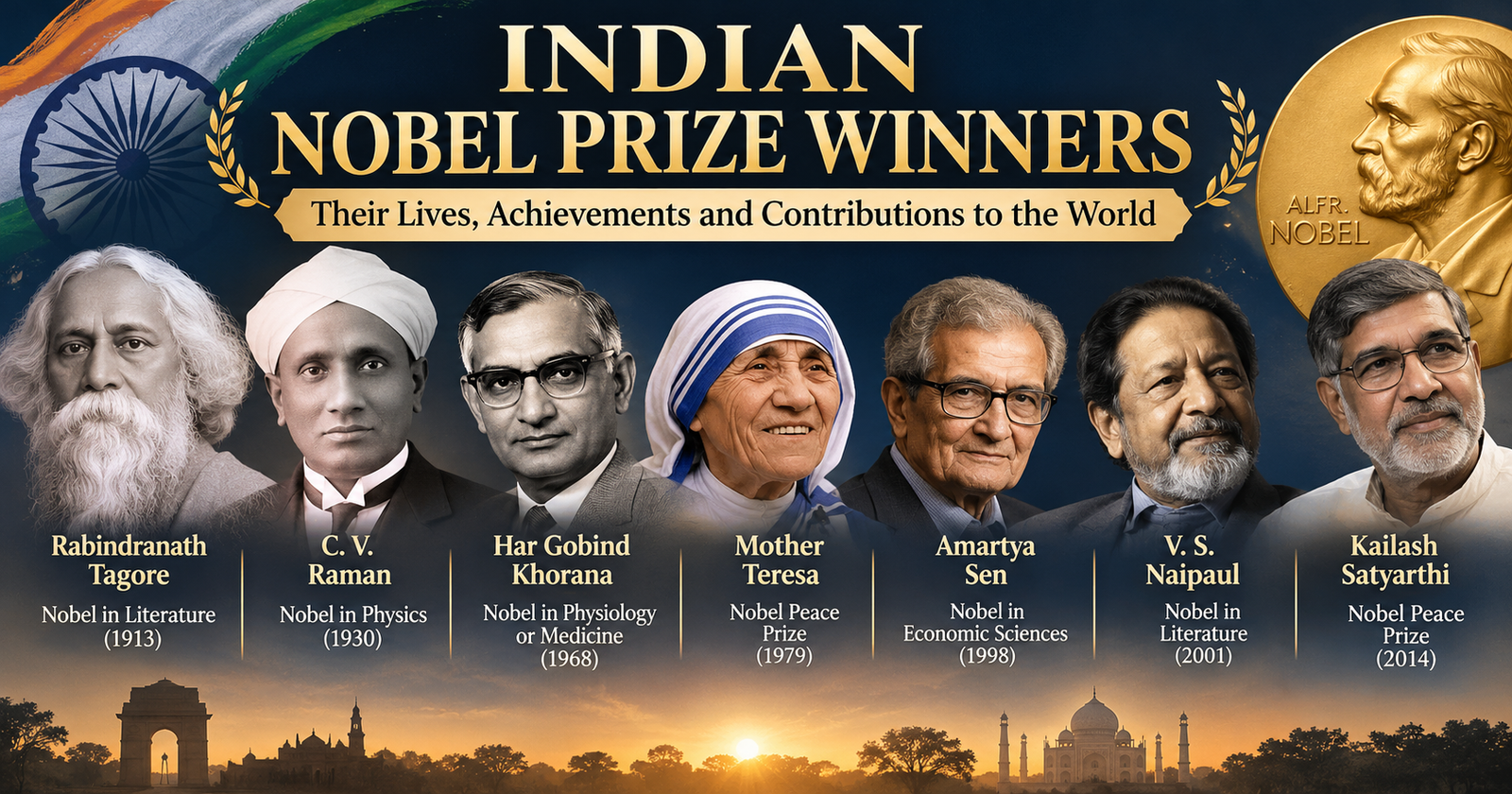
7. Which Indian-born scientist won the Nobel Prize in Chemistry in 2009?
Venkatraman Ramakrishnan received the 2009 Nobel Prize in Chemistry, shared with Thomas A. Steitz and Ada E. Yonath.
Their research examined the structure and function of ribosomes.
8. Which Indian-born scientist is known for the Chandrasekhar limit?
Subrahmanyan Chandrasekhar is known for the Chandrasekhar limit, which describes the maximum mass of a stable white dwarf under the relevant theoretical assumptions.
He received the Nobel Prize in Physics in 1983.
9. Who won the Nobel Peace Prize for fighting child labor in India?
Kailash Satyarthi received the Nobel Peace Prize in 2014, jointly with Malala Yousafzai.
His work focused on ending child labor and exploitation and protecting children’s right to education.
10. Is the Dalai Lama an Indian Nobel laureate?
The Dalai Lama was born in Tibet, not India. He has lived in India since 1959 and received the Nobel Peace Prize in 1989.
He is therefore included here as a Nobel laureate with a significant connection to India, rather than as an Indian-born laureate.
11. Did all Indian-born Nobel laureates conduct their research in India?
No. Several laureates conducted their Nobel-winning research abroad.
For example, Khorana worked in Canada and the United States, Chandrasekhar worked in the United States, and Ramakrishnan worked in the United Kingdom.
Raman’s Nobel-winning research, by contrast, was conducted in India.
12. Why are Ronald Ross and Rudyard Kipling included in this article?
Both were born in British India before the country became independent.
Ronald Ross was born in Almora and received the 1902 Nobel Prize in Physiology or Medicine.
Rudyard Kipling was born in Bombay and received the 1907 Nobel Prize in Literature.
Both were British nationals, not Indian citizens. They are included because of their Indian birthplace.
13. Was V. S. Naipaul an Indian Nobel laureate?
No. V. S. Naipaul was born in Trinidad and Tobago and was a British writer of Indian ancestry.
He received the 2001 Nobel Prize in Literature.
His connection with India was through his family background and his writing about the country.
14. Is Navi Pillay an Indian Nobel laureate?
Navi Pillay is a South African jurist of Indian Tamil ancestry.
She received the 2026 Nobel Peace Prize for her work promoting peace and international law.
She was born in Durban, South Africa, and should be described as a South African Nobel laureate of Indian ancestry.
15. What is the difference between the Nobel Prize in Economic Sciences and the original Nobel Prizes?
The Sveriges Riksbank Prize in Economic Sciences in Memory of Alfred Nobel was established in 1968 and first awarded in 1969.
It is administered alongside the Nobel Prizes and follows the same general award process, but it was not one of the five original prize categories established in Alfred Nobel’s will.
India’s Lasting Contribution to the Nobel Prize
The stories of Nobel laureates connected with India represent different forms of achievement.
Rabindranath Tagore brought Indian literature to international attention. C. V. Raman showed how scientific discoveries made in India could transform global research. Har Gobind Khorana contributed to the understanding of the genetic code. Subrahmanyan Chandrasekhar helped explain the evolution of stars.
Amartya Sen and Abhijit Banerjee changed the way economists study poverty and human development. Venkatraman Ramakrishnan advanced our understanding of the molecular machinery of life.
Mother Teresa, the Dalai Lama and Kailash Satyarthi brought attention to humanitarian service, non-violence and children’s rights.
Ronald Ross and Rudyard Kipling were born in colonial India and later received international recognition as British writers and scientists. V. S. Naipaul and Navi Pillay demonstrate the influence of Indian ancestry in literature and international law.
Their contributions are different, but their impact reaches beyond national boundaries.
The Nobel Prize is not simply a recognition of individual success. It also provides a record of ideas, discoveries and actions that have changed the way people understand the world.
India’s connection with the Nobel Prize is therefore a story of literature, scientific curiosity, intellectual achievement and service to humanity.
These laureates continue to inspire students, researchers, writers, economists and social workers. Their lives demonstrate that knowledge and commitment can create an impact far beyond the circumstances in which a person begins their journey.
For India, their achievements are an important part of its contribution to the world.
References and Further Reading
The following official resources should be used as primary references when fact-checking or updating this article.
- Rabindranath Tagore – Nobel Prize in Literature 1913
- C. V. Raman – Nobel Prize in Physics 1930
- Har Gobind Khorana – Nobel Prize in Physiology or Medicine 1968
- Mother Teresa – Nobel Peace Prize 1979
- Subrahmanyan Chandrasekhar – Nobel Prize in Physics 1983
- The 14th Dalai Lama – Nobel Peace Prize 1989
- Amartya Sen – Nobel Prize in Economic Sciences 1998
- V. S. Naipaul – Nobel Prize in Literature 2001
- Venkatraman Ramakrishnan – Nobel Prize in Chemistry 2009
- Kailash Satyarthi – Nobel Peace Prize 2014
- Abhijit Banerjee – Nobel Prize in Economic Sciences 2019
- Ronald Ross – Nobel Prize in Physiology or Medicine 1902
- Rudyard Kipling – Nobel Prize in Literature 1907
- Navi Pillay – Nobel Peace Prize 2026
Official master list: All Nobel Prizes and Nobel Laureates
Additional institutional references:
- United Nations
- World Health Organization
- UNESCO
- United Nations Development Programme
- International Labour Organization
Editorial note: This article distinguishes between Indian-born laureates, people born in pre-Partition British India, foreign-born laureates who lived and worked in India, and laureates of Indian ancestry. Nobel Prize categories and award motivations follow the official laureate records. Historical and biographical details should be checked against the cited institutional sources before publication.



[…] the board’s decisions about leadership and governance will matter. Investors will want to know whether Huang remains in charge, whether independent […]